


CPR Certification in Ontario: Which Level You Need and How to Get Certified in London
- Forest City First Aid

- 24 hours ago
- 20 min read
Every 10 minutes, someone in Canada experiences a cardiac arrest outside of a hospital setting. Knowing how to respond in those critical moments can mean the difference between life and death. That is why CPR certification is one of the most valuable skills any person can have, whether you are a healthcare professional, a parent, a teacher, or simply someone who wants to be prepared.
If you live in Ontario and you are looking to get certified in London, you may already be wondering where to start. The process can feel overwhelming at first, especially when you discover there are multiple certification levels designed for different needs and roles.
This guide is here to simplify everything for you. We will walk you through the different CPR certification levels recognized in Ontario, help you determine which one is the right fit for your situation, and show you exactly how to get certified right here in London. By the end, you will have a clear, confident path forward and the knowledge to take your first step toward becoming a certified lifesaver.
Why CPR Certification Matters More Than Ever in 2026
Cardiac arrest does not announce itself. It can strike a coworker in a boardroom, a classmate in a gymnasium, or a family member at home, and when it does, every second counts. Emergency responders typically take 4 to 10 minutes to arrive on scene, but without CPR, survival chances drop by 7 to 10 percent with every passing minute. When a bystander steps in and begins CPR immediately, survival rates can increase by as much as 45 percent, according to CPR facts and statistics from the American Heart Association. Despite this, only 41.7 percent of out-of-hospital cardiac arrest patients currently receive bystander CPR, revealing a persistent and urgent training gap that certified courses directly address.
The scale of demand for CPR certification reflects this urgency. The global CPR and first aid training market is valued at $4.8 billion USD in 2025 and is projected to reach $8.9 billion by 2034, driven by rising cardiac arrest incidence and mandatory workplace safety regulations. Closer to home, Ontario's WSIB First Aid Program introduced a significant naming update effective June 22, 2026, aligning course terminology with updated Canadian Standards Association standards. Legacy course names have been replaced, and workers or employers booking training without understanding this change risk selecting the wrong certification for their compliance needs.
Choosing the correct certification level from the outset matters whether you are fulfilling a school placement requirement, starting a new job, or meeting WSIB workplace obligations. Booking the wrong course means lost time, rebooking costs, and potential compliance gaps. Forest City First Aid serves individuals and corporations across London, Toronto, and the GTA with WSIB-compliant courses that already reflect the current 2026 CSA-aligned terminology, including Intermediate First Aid and CPR-C/AED, so clients can book with confidence.
The 3 CPR Certification Levels in Ontario Explained
Not all CPR certifications are created equal, and choosing the wrong level for your role is one of the most common mistakes Ontario learners make. Understanding the three recognized tiers will save you time, money, and the frustration of arriving at a placement or new job without the right credentials in hand.
CPR Level A: Entry-Level Protection for Low-Risk Settings
CPR Level A is the most foundational certification available, and it is designed for individuals working in environments where adult emergencies are the primary concern. This level covers adult chest compressions, rescue breaths, adult choking response, and basic AED operation. It is a practical starting point for office workers, retail employees, and volunteers who want a working knowledge of resuscitation without the broader scope of pediatric training. Because Level A does not include techniques for children or infants, it is generally not accepted for roles in schools, childcare settings, or most regulated workplaces in Ontario. If your employer requires a specific certification, confirm the required level before booking, since Level A will not satisfy requirements designed for Level C.
CPR Level C: The Ontario Workplace Standard
CPR Level C is the certification that most Ontario workers, students, and placement candidates will need, and for good reason. It expands on Level A by adding CPR techniques for children and infants alongside adult resuscitation, full AED operation, and in many courses, two-rescuer CPR scenarios. This makes it applicable to a much wider range of real-world emergencies. Level C is the accepted standard for most regulated roles in Ontario, including early childhood educators, lifeguards, fitness instructors, and virtually all workers in environments subject to WSIB oversight under Ontario Regulation 1101. Healthcare students completing clinical placements will frequently see Level C listed as a minimum requirement on their placement documentation. According to Ontario Tech University's continuing education catalogue, CPR-C is offered specifically to meet the recertification needs of healthcare students, reflecting how broadly this level is demanded across sectors.
CPR-HCP / BLS: The Healthcare Professional Standard
CPR-HCP, also referred to as BLS (Basic Life Support), is the advanced tier designed for nurses, paramedics, respiratory therapists, personal support workers, and other clinical professionals. It builds significantly on Level C by incorporating multi-rescuer resuscitation protocols, bag-valve-mask ventilation, and advanced airway management techniques that reflect the realities of a clinical emergency response environment. The American Heart Association's BLS program is one of the globally recognized frameworks for this level, and Ontario training providers align their HCP courses with comparable standards for professional validation.
Bundling and Compliance: Getting the Right Combination
All three levels can be paired with first aid training to create a bundled certification, and this combination represents the most popular booking pattern among Ontario learners. Combined CPR and first aid training accounts for 42.5% of the global training market, which reflects how consistently workers across industries need both skill sets together. Each level is recognized by WSIB and satisfies Ontario Regulation 1101 requirements when delivered by an approved provider, but compliance depends entirely on selecting the correct level for your specific role. Forest City First Aid offers CPR-C/AED and CPR-HCP/BLS as both standalone and bundled courses, giving learners a straightforward way to match their certification to their exact workplace or institutional requirement without paying for training beyond what they need.
Which CPR Certification Level Do You Actually Need?
Your job role is the single most important factor when determining which CPR certification level you actually need. Getting this right before you register saves you time, money, and the frustration of having to retake a course because your employer or placement coordinator requires a different level. The good news is that once you understand how Ontario's certification framework maps to different roles and industries, the decision becomes straightforward.
Your Role Determines Your Level
For most general workplace settings, including office environments, retail stores, hospitality, and customer-facing roles, CPR-C is the standard requirement. CPR-C covers resuscitation for adults, children, and infants, includes AED training for all age groups, and is broadly accepted across Ontario workplaces and organizations. Healthcare professionals operate under a different standard. Nurses, personal support workers (PSWs), dental hygienists, paramedics, and medical students are typically required to hold CPR-HCP/BLS, which incorporates advanced protocols such as bag-mask ventilation and team-based resuscitation alongside the full CPR-C skillset. If you work directly with patients or provide clinical care in any capacity, CPR-HCP/BLS is almost certainly what your employer or licensing body expects.
According to this guide to choosing the right CPR certification level, the determining factors in Ontario include not just your job title but also your workplace risk level, the number of workers on shift, and any specific requirements from your employer or licensing body. Understanding all of these inputs before you book is the key to selecting correctly the first time.
Ontario School and Placement Requirements
Post-secondary students heading into placement must pay close attention to their program's specific requirements. Ontario college programs commonly mandate CPR-C at minimum for any student entering a placement setting. However, Early Childhood Education (ECE) programs and nursing programs routinely require the full CPR-HCP/BLS level, bundled with Intermediate First Aid, before a student can begin their placement hours. If you are currently enrolled in an ECE, nursing, or allied health program, review your placement documentation carefully. Many students are surprised to discover that a basic CPR-C certificate is insufficient and that they need to complete a more comprehensive course package before their start date.
Role-Based Comparison Table
The table below summarizes which certification level applies to common roles, what is included, and the corresponding Forest City First Aid course for each.
Workplace Risk Level and Regulation 1101
The risk profile of your industry is a formal compliance factor under Ontario's Regulation 1101. Higher-risk environments, including construction sites, manufacturing facilities, logistics operations, and healthcare settings, require higher certification levels and a greater ratio of trained first aiders per shift. A manufacturing floor with multiple workers operating heavy machinery carries a fundamentally different emergency risk profile than a small administrative office. Employers in these sectors are legally obligated to ensure adequate coverage, which means more certified staff and higher credential standards across the board. If you work in any of these industries, confirm your specific requirements with your employer before registering, as Ontario's 2026 first aid training requirements outline how workplace context directly shapes the certification level and course bundling you will need.
Parents, Volunteers, and Personal Preparedness
If you are seeking CPR certification for personal reasons rather than a specific job requirement, CPR-C is your strongest choice. It covers resuscitation techniques for all age groups, which is particularly valuable for parents of young children, grandparents, coaches, and community volunteers who may encounter emergencies involving people of any age. CPR-C is also the most universally recognized non-healthcare level across Ontario organizations, meaning that if a volunteer role, community program, or future employer ever asks about your certification, CPR-C will meet the requirement in the vast majority of cases.
When in Doubt, Default to CPR-C
For most non-healthcare workers, CPR-C is the safest default. It exceeds the requirements for low-risk workplaces, satisfies most school and volunteer programs, and provides a comprehensive skillset that is genuinely useful in real emergencies. That said, if you work in healthcare, childcare, or a high-risk industrial environment, do not assume. Confirm the exact certification name and level required by your employer, licensing body, or placement coordinator before booking your course. Taking a few minutes to verify upfront ensures your certification is accepted on day one.
The 2026 WSIB First Aid Naming Changes: What Ontario Workers and Employers Need to Know
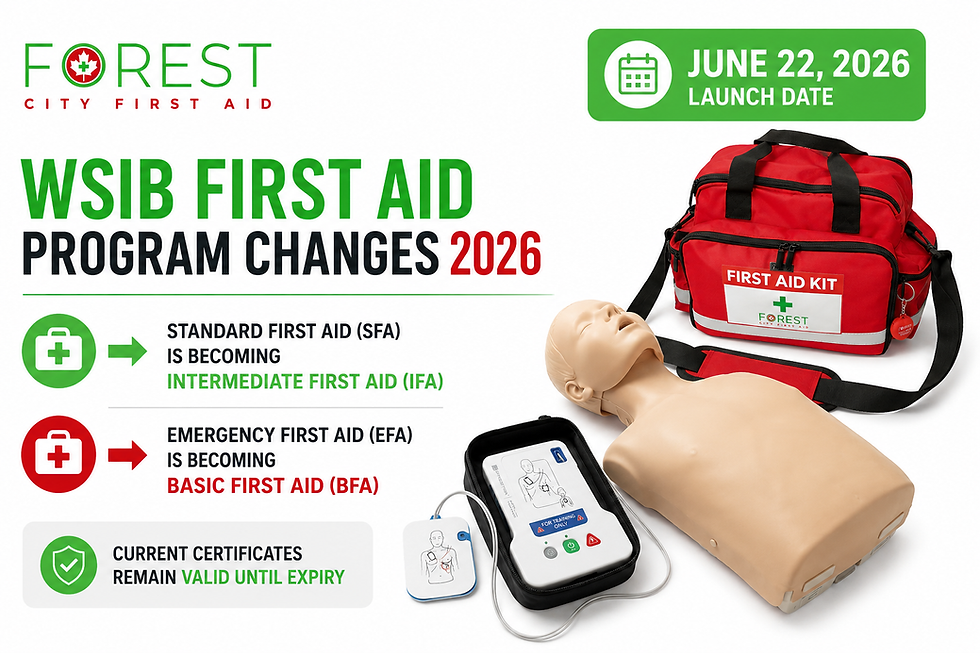
Effective June 22, 2026, Ontario's WSIB First Aid Program completed the most significant administrative update to its course structure in decades. Working in alignment with the national Canadian Standards Association (CSA) Z1210:24 standard, the WSIB formally retired legacy course names that Ontario workplaces had used for years and replaced them with standardized terminology used across Canada. The training content itself, the certification requirements under Ontario Regulation 1101, and the three-year validity period for certificates all remained completely unchanged. Only the names were updated. For a full overview of the official transition, the Ontario First Aid Course Name Changes (June 22, 2026) published by Assured Response provides a detailed breakdown directly aligned with WSIB's confirmed language.
The New Course Name Reference Table
The following table shows exactly how the legacy course names map to the new CSA-aligned terminology:
CPR level names were not affected by the transition, which means your CPR-C or CPR-HCP certification terminology remains exactly as it was. The impact of this update is limited entirely to the first aid course tier names listed above.
What This Means for Your Existing Certificate
If you hold a certificate issued under the name "Standard First Aid" or "Emergency First Aid" by a WSIB-approved provider before June 22, 2026, that certificate remains fully valid for its entire three-year certification period. No early renewal is required, and no employer is entitled to reject a certificate simply because it carries the legacy course name. The WSIB has confirmed that the old and new names are direct equivalents, meaning a "Standard First Aid" certificate and an "Intermediate First Aid" certificate issued after June 22, 2026, carry identical compliance weight under Regulation 1101. You do not need to retrain early. Simply renew under the new course name when your current certificate expires.
How Forest City First Aid Was Already Ahead of the Transition
Forest City First Aid had already adopted the term "Intermediate First Aid" in its course lineup prior to the June 2026 changeover. This was not a coincidence; it reflected an intentional alignment with the direction the industry was heading. For FCFA clients, there was no moment of confusion, no need to reconcile unfamiliar names, and no disruption to booking or records. The transition that prompted questions and updates across Ontario was a non-event for anyone already trained through FCFA.
What Employers Must Do Now
For HR teams and safety coordinators, the administrative side of this update requires some deliberate attention. Update all internal training records, onboarding checklists, and workplace safety plans to reflect the new course names. During a WSIB audit, documentation that references "Standard First Aid" when your workers now hold "Intermediate First Aid" certificates can create unnecessary confusion, even if the certifications themselves are compliant. Proactively updating your paperwork eliminates that friction before it becomes a problem. Employers should also verify that any new training booked going forward is with a WSIB-approved provider, as only certifications from approved agencies are accepted for compliance purposes.
Searching for Courses Under the Old Names
Many Ontario workers are still searching online using terms like "Standard First Aid London Ontario" because that is the language they have known for years. If that describes you, know that Forest City First Aid's Intermediate First Aid and CPR-C/AED course is the direct equivalent of what was formerly called Standard First Aid. It is a two-day in-person program, fully compliant with WSIB Regulation 1101, and available in London, Toronto, and the GTA, with the ability to travel anywhere in Ontario for group training. For additional context on what the Canadian Red Cross First Aid course changes mean for students navigating this transition, that resource provides useful supplementary detail. The course you need has not changed. The name has simply caught up with the national standard.
WSIB Compliance for Ontario Employers: What Regulation 1101 Requires
Ontario employers face a compliance obligation that catches many organizations off guard: the legal requirement to maintain certified first aid responders in the workplace at all times during operational hours. Ontario Regulation 1101, enacted under the Workplace Safety and Insurance Act, 1997, is the governing framework that dictates exactly how many certified first aiders your workplace must have on-site, and what level of certification they must hold. The regulation applies to virtually all Ontario workplaces covered under the WSIB system, and ignorance of its requirements is not a recognized defence during an inspection.
How Worker-Per-Shift Ratios Work
The staffing formula under Regulation 1101 is built around the number of workers present during any given shift, not your total headcount. A small shift of five or fewer workers in a low-hazard environment may satisfy requirements with one worker holding a Basic First Aid certificate (formerly called Emergency First Aid under the legacy terminology). As shift sizes grow, the number of required certified responders increases proportionally. For larger shifts, employers may be required to have workers holding an Intermediate First Aid certificate on duty at all times. Because these thresholds apply per shift rather than per facility, multi-shift operations must plan their certification coverage across every rotation, including overnight and weekend crews.
Risk Classification Changes the Equation
Workplace hazard level is the second variable that shapes your compliance obligations, and it carries significant weight. A general office environment is typically categorized as lower-hazard, which generally allows for fewer mandatory certified responders relative to headcount. By contrast, construction sites, warehouses, manufacturing floors, and other physically demanding or equipment-intensive environments are classified as higher-hazard workplaces, which carry stricter requirements for both the number of certified staff and the level of certification required. An employer operating a warehouse with forty workers per shift cannot apply the same staffing formula as a ten-person accounting office. Understanding your workplace's specific hazard classification under the WSIB framework is a foundational step before you can accurately assess your training needs.
Employer Obligations Beyond the Certificate
Holding a certification is only part of the picture. Employers bear the ongoing responsibility of ensuring that certificates remain current, that staff hold the correct level of certification for their workplace category, and that records are properly maintained and accessible for inspection. Standard first aid certifications are typically valid for three years, meaning renewal must be planned proactively rather than reactively. A lapsed certificate discovered during a WSIB audit creates immediate liability exposure. Organized record-keeping, tracked renewal windows, and a clear internal process for replacing certifications when staff change roles or leave the organization are all part of a functional compliance program.
Why Corporate Investment in Training Is Accelerating
The urgency businesses are placing on first aid compliance is not isolated to Ontario. The corporate end-user segment is the fastest-growing category globally in the CPR and first aid training market, expanding at a CAGR of 8.4%. This reflects a broader shift in how organizations treat employee health and safety, viewing it as a core operational investment rather than a box-checking exercise.
Forest City First Aid supports London, Toronto, and GTA-area employers with corporate and group training options designed around real operational constraints. On-site delivery removes the logistical burden of transporting staff off-site, and scheduling flexibility means training can be structured around shift rotations without disrupting production or service continuity. HR managers and safety officers are encouraged to contact Forest City First Aid directly for a compliance consultation that maps your current staff certifications against Regulation 1101 requirements, identifies any gaps, and builds a renewal plan before your next audit cycle.
How Long Is CPR Certification Valid in Ontario?
CPR certification validity in Ontario is not one-size-fits-all, and understanding the difference can protect both your career and your workplace compliance standing. Validity periods vary based on the issuing organization and the specific course completed. Certifications issued through Heart & Stroke, such as BLS Provider (CPR-HCP), are valid for one year. Certifications issued through the Canadian Red Cross, including Standard First Aid and CPR/AED Level C, are typically valid for three years. If you are unsure which applies to your certificate, check the expiry date printed directly on your card and confirm with your training provider.
WSIB Compliance Requires Proactive Renewal
For Ontario workplaces governed by WSIB's First Aid Program, one rule applies without exception: certifications must remain current at all times. An expired certificate does not satisfy your employer's obligations under Regulation 1101, and a lapse, even by a few days, can create compliance exposure during a WSIB inspection. Employers should maintain a centralized tracking system for all employee certification expiry dates and build in a renewal window of at least four to six weeks before expiry. Waiting until a certificate has already lapsed creates a more serious problem: expired certificate holders cannot register for the shorter recertification course and must instead complete the full initial certification again. Proactive scheduling is not just a best practice; it is the only practical approach to continuous compliance. The WSIB First Aid Program outlines approved provider requirements and what is recognized for workplace certification.
Healthcare Providers and Annual Renewal Cycles
Healthcare professionals follow a tighter renewal cycle than most. BLS certifications required for nurses, paramedics, respiratory therapists, and other clinical roles are valid for one year, making annual recertification a routine professional obligation rather than an exception. Many hospitals and licensing colleges require proof of current certification before a shift begins or a placement is confirmed, not simply before the expiry date arrives. Building annual recertification into your professional calendar, the same way you would schedule a license renewal, eliminates last-minute scrambles and ensures you are never caught without valid credentials.
Recertification Courses Save Time and Money
Renewal courses are designed specifically for previously trained individuals. They skip foundational theory and focus on skills review, scenario practice, and updated protocols, making them significantly shorter and more affordable than initial certification courses. This structure allows working professionals and busy employers to keep teams compliant without disrupting operations. For those who need more detail on how to recertify or renew first aid and CPR certifications, current guidance is available outlining course options by issuing body and delivery format.
Forest City First Aid offers recertification options for both CPR-C/AED and CPR-HCP/BLS. If your certificate is approaching its expiry date and you are based in London, the GTA, or anywhere across Ontario, booking a renewal course through FCFA's current schedule keeps your credentials current without the time commitment of starting from scratch.
Why In-Person CPR Training Still Outperforms Online-Only Alternatives
Despite the rapid growth of online learning platforms, in-person CPR training continues to hold 48.3% of global market revenue share, making it the dominant delivery format worldwide. This is not a legacy preference or an industry slow to adapt. It is a direct reflection of a fundamental reality: CPR is a physical skill, and physical skills require physical practice to be performed correctly when it matters most.
The reason hands-on training remains irreplaceable comes down to the mechanics of effective CPR itself. Correct compression depth, proper hand placement, adequate chest recoil between compressions, and the right rate of delivery are all elements that must be felt and corrected in real time, not simply read about or watched on a screen. As noted in research comparing delivery formats, online CPR courses cannot fully replicate the tactile feedback of chest compressions or rescue breathing, and immediate instructor correction is critical for mastering these techniques. An instructor watching you work on a mannequin can spot a problem with your wrist position or compression depth instantly. A video module cannot.
For Ontario workplaces, this distinction carries legal weight. WSIB compliance under Regulation 1101 requires demonstrable physical competency, not just knowledge recall. Fully online CPR courses do not satisfy Ontario's workplace regulatory requirements on their own. Employers who rely on online-only certification for their designated first aid responders are not in compliance, regardless of how polished the digital course materials appear.
It is worth acknowledging that blended and online CPR formats have legitimate value as knowledge-building tools, particularly for general public awareness. However, industry consensus is consistent: digital theory components work best as supplements to classroom instruction, not replacements, especially in healthcare, childcare, and industrial environments where certification must reflect genuine competency.
Forest City First Aid's classroom-based model in London, with travel available across Ontario, is built on this standard. Every participant completes hands-on mannequin practice and receives direct instructor feedback throughout the session. The certification earned reflects what a person can actually do under pressure, not simply what they answered correctly on a quiz.
CPR Certification Courses at Forest City First Aid
Forest City First Aid (FCFA) offers a focused lineup of CPR certification courses designed to meet the specific needs of Ontario workers, healthcare professionals, students, and employers. Whether you are seeking basic CPR competency or an advanced credential required by a regulated healthcare employer, FCFA has a clearly defined pathway for your situation.
CPR-C/AED: The Standard for Most Ontario Workplaces
The CPR-C with AED course is FCFA's foundational CPR certification, covering CPR techniques for adults, children, and infants, along with choking response procedures, two-rescuer CPR skills, AED operation, and basic emergency response. Certification is valid for two years. This course is the appropriate choice for the majority of Ontario workers who need to demonstrate CPR competency for employment, and it directly satisfies the CPR component of the WSIB Intermediate First Aid requirement under Ontario Regulation 1101 when paired with the first aid component. Classes are available on a regular schedule in both London and Toronto, making it accessible to learners across southern Ontario without long travel commitments.
CPR-HCP/BLS: Built for Healthcare Professionals
The CPR-HCP/BLS with AED course is specifically designed for nurses, physicians, paramedics, allied health professionals, and students enrolled in healthcare programs. This is not simply a more intensive version of CPR-C; it is a distinct credential that addresses the clinical resuscitation standards required by hospitals, clinics, and regulated healthcare employers across Ontario. The curriculum covers two-rescuer CPR coordination, advanced airway management techniques, and the precise resuscitation protocols that healthcare facilities expect staff to demonstrate before patient contact begins. Like CPR-C, certification is valid for two years. If you are completing a nursing or allied health placement, confirm with your program coordinator that CPR-HCP/BLS is the required level before registering.
Intermediate First Aid + CPR-C/AED: The Most In-Demand Bundle
The Intermediate First Aid with CPR-C and AED course is FCFA's most popular offering, and for good reason. This two-day program delivers comprehensive first aid and CPR training in a single enrollment, earns a three-year certification, and is explicitly badged as 2026 WSIB First Aid Program Compliant on the FCFA website. For employers managing workplace compliance obligations, school placement students, and corporate onboarding programs, this bundle covers both regulatory requirements simultaneously. Readers familiar with the older course name will recognize this as the course previously known as Standard First Aid, updated to align with the 2026 CSA/WSIB naming standard.
Where FCFA Delivers Training and What Else They Offer
FCFA serves London, Ontario as its primary base with consistent public classroom scheduling, and extends full service delivery to Toronto and the GTA through a dedicated regional contact line. For organizations outside those centres, FCFA can travel to any location across Ontario to deliver private on-site group training, an option available through the Private and Corporate Booking section of the website. Beyond CPR and first aid courses, FCFA also provides Airway Management certification, Naloxone Training, AED and first aid kit servicing, and N95 mask fit testing, allowing employers to consolidate multiple workplace safety requirements under a single provider relationship rather than managing several vendors.
Booking is completed directly through the Forest City First Aid website, where course schedules for London and Toronto are listed with a built-in cart function. Corporate groups and HR teams with volume needs or custom scheduling requirements are encouraged to reach out through the Private and Corporate Booking contact pathway to discuss options tailored to their organization.
CPR Certification in Ontario: Frequently Asked Questions
What is the difference between CPR-C and CPR-HCP/BLS?
CPR Level C covers resuscitation techniques for adults, children, and infants, making it the appropriate standard for most Ontario workplaces and the general public. CPR-HCP (Health Care Provider) and BLS (Basic Life Support) are functionally equivalent designations used in healthcare settings. These courses go beyond CPR-C by incorporating two-rescuer CPR techniques, advanced airway management, and clinical scenario practice. If you work in nursing, paramedicine, dental hygiene, respiratory therapy, or another regulated health profession in Ontario, your licensing body will almost certainly require CPR-HCP/BLS rather than CPR-C. When in doubt, check your program's placement requirements before registering.
Is CPR certification the same as first aid certification?
No, and this is one of the most common points of confusion among new learners. CPR is a specific skill set focused on cardiac and respiratory emergencies. First aid is a broader competency that covers bleeding control, fractures, burns, allergic reactions, and a wide range of other medical situations. Most Ontario employers and post-secondary placement programs require both, which is why the combined Intermediate First Aid and CPR-C/AED course is the most frequently booked option at Forest City First Aid. Enrolling in the bundled format satisfies both requirements in a single training commitment, saving you time and ensuring your documentation is complete for workplace or placement submission.
What changed with the WSIB first aid course names in 2026?
Effective June 22, 2026, Ontario's WSIB First Aid Program updated its course names to align with the Canadian Standards Association (CSA) Z1210:24 national standard. "Emergency First Aid" is now called "Basic First Aid," and "Standard First Aid" is now called "Intermediate First Aid." The training content, legal compliance value, and employer obligations under Regulation 1101 have not changed. Certificates issued under the old names remain valid. If you are an employer updating your training records or an employee who recently completed a course, only the label has changed, not the standard you were trained to.
How long does a CPR certification course take?
A standalone CPR-C/AED course typically runs half a day, making it accessible for workers who need a quick certification update. Combined Intermediate First Aid and CPR-C/AED courses are delivered over two days to accommodate the expanded first aid curriculum alongside hands-on CPR and AED skills practice. CPR-HCP/BLS courses are generally completed in a half-day to full-day format depending on scheduling and group size. Forest City First Aid offers flexible scheduling options to accommodate both individual learners and corporate groups across London, Toronto, and the GTA.
Can I get CPR certified online in Ontario?
Fully online CPR courses do not meet WSIB workplace compliance requirements in Ontario. The hands-on skills component, including chest compressions on a manikin and AED practice, cannot be evaluated remotely. Blended formats that pair online theory modules with an in-person skills assessment may satisfy certain requirements, but for most workplaces and clinical placements, a classroom-based course with direct instructor evaluation is required. This is consistent with current guidance on Ontario first aid training standards and aligns with why in-person training continues to dominate the market.
Does Forest City First Aid offer corporate group training?
Yes. Forest City First Aid provides group and corporate training for employers in London, Toronto, and across the GTA, with on-site delivery and flexible scheduling available to minimize disruption to your operations. Whether your team needs CPR-C/AED certification, Intermediate First Aid, or CPR-HCP/BLS for a healthcare setting, FCFA can coordinate a compliant solution aligned with your WSIB obligations. Contact FCFA directly to discuss your organization's certification requirements, group size, and preferred delivery format.
Getting CPR Certified in Ontario: Your Next Steps
Before you book any course, use the role-based comparison covered earlier in this guide to confirm exactly which certification level your employer, school, or placement coordinator requires. Completing the wrong course is a costly and avoidable mistake, and it is one of the most common reasons Ontario learners find themselves rebooking training within weeks of completing it.
If you are an Ontario employer, take time now to audit your staff certification records against Regulation 1101 requirements. Confirm that course names on file reflect the updated 2026 CSA-aligned terminology where applicable, replacing legacy terms with Basic First Aid and Intermediate First Aid as the new standard naming conventions. Outdated course names on employee records can create compliance gaps during a WSIB inspection, even when the underlying training was valid at the time it was completed.
For most individuals in London, Ontario booking certification for work, school, or a community placement, the Intermediate First Aid and CPR-C/AED course at Forest City First Aid is the correct starting point. Delivered over two instructor-led days, it satisfies the broadest range of employer and placement requirements in a single training block.
Book directly with Forest City First Aid for WSIB-compliant, hands-on CPR and first aid certification in London. Corporate and on-site training options are available across Ontario.
Conclusion
CPR certification in Ontario does not have to be confusing or overwhelming. By understanding the different certification levels, choosing the one that matches your role and responsibilities, and finding a reputable training provider right here in London, you are already ahead of most people.
Here is what to remember: each level serves a specific purpose, recertification keeps your skills sharp, and taking action today could save a life tomorrow. The knowledge you gain in a CPR course stays with you far beyond the classroom.
Now it is time to take the next step. Browse local London training providers, register for the certification level that fits your needs, and commit to a course date. You have the information. You have the motivation. All that is left is showing up and becoming someone who is ready when it matters most.


Comments